 Full control
Own winter clothing
Layers from the suitcase
- Base
- Wool on the skin
- Outer
- Windproof jacket and pants
- Good for
- Travelers with ski equipment
Guides
Language
EnglishCurrency
US dollar · $GetYourGuide shows its prices in the currency you pick.
Guide · Clothing
The right clothing for the northern lights safari in Tromsø determines whether you enjoy the night or just freeze. Here you will read which layers, shoes, and extras you need.
Editorial tromsonordlichter.deUpdated on October 2, 20266 min read4 sources
In short
A northern lights night is largely made up of waiting. You stand on snow, sit by the fire, or stare up at the sky for a long time without moving much. That is when the body loses heat the fastest. Whoever is freezing checks the clock instead of looking up, and whoever wants to head back to warmth too early may miss the moment when the sky suddenly lights up green.
The cold in Tromsø is often milder than you would expect this far north. In winter, the average temperature hovers around −4 °C.2 That sounds harmless, but it becomes a real challenge once wind picks up, you stand still for hours, and the ground beneath you is nothing but snow and ice. What matters then is not the number on the thermometer, but what you wear on your body.
The good news: staying warm is no magic trick. It is not about one expensive jacket, but about a well-thought-out layering system that traps warmth, wicks moisture outward, and blocks wind. With this system, good shoes, and warm accessories, you will comfortably get through a long night outdoors and can focus entirely on the sky.
Visit Tromsø recommends starting with wool directly on the skin and wearing warm, dry sweaters and jackets over it.1 Merino wool underwear still keeps you warm even when it gets a little damp, and it does not smell quickly after a long night. Cotton, on the other hand, absorbs sweat, stays wet, and chills you from the inside. Leave it in your suitcase for this night.
Over the base layer comes a warming mid-layer: a thick wool sweater, a fleece jacket, or a light down vest. This layer keeps the warm air close to your body. You are better off wearing several thinner layers than one very thick one, because you can then adjust if you get too warm in the vehicle or by the fire, and you are still well prepared once you step outside again.
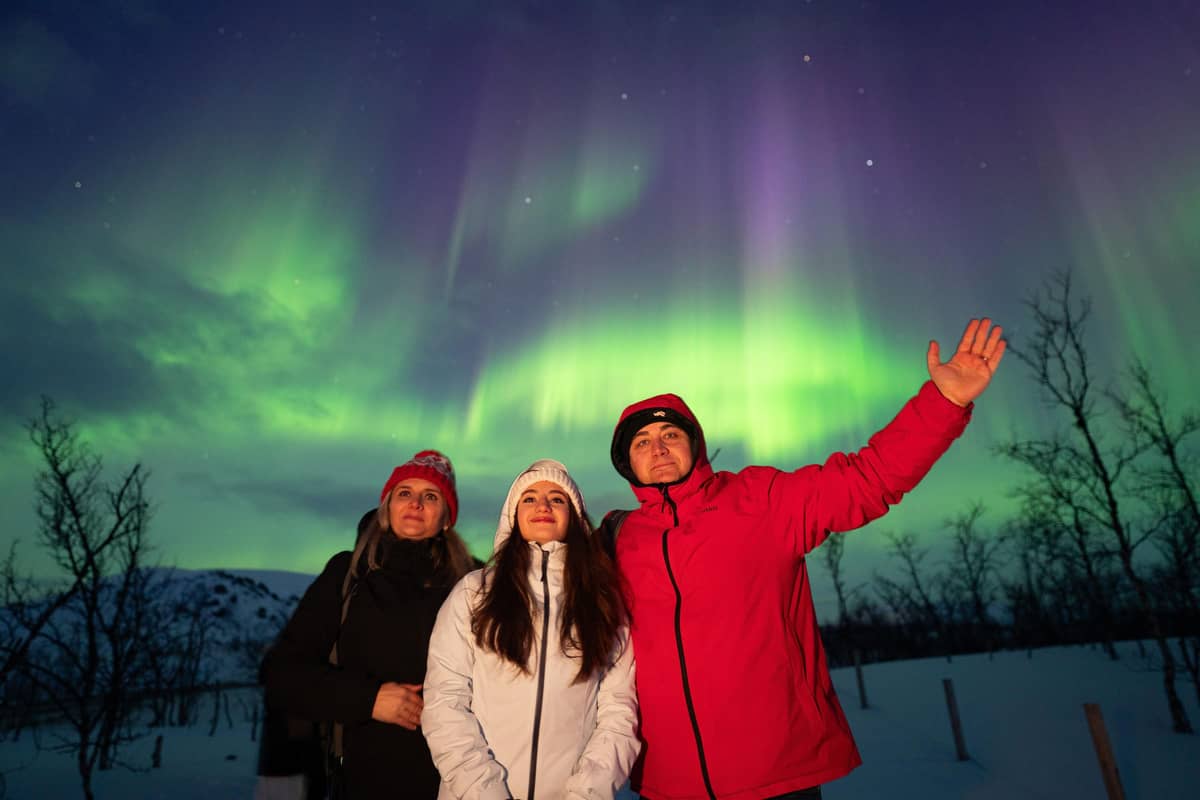
On the outside, wear a windproof, water-resistant jacket and a matching pair of pants. Wind is a major heat stealer along the coast and in open areas. Insulated ski pants over long johns are ideal, because they stay warm even when you sit down in the snow or kneel to take a photo. Make sure the jacket extends past the waistband of the pants.
Month by Month
| Month | Precipitation | Precipitation Days | What to pack |
|---|---|---|---|
| September | 111 mm | 12 | Waterproof outer shell |
| October | 129 mm | 13 | Waterproof jacket and pants |
| November | 93 mm | 11 | Full winter clothing |
| December | 110 mm | 12 | Winter clothing and heat packs |
| January | 109 mm | 12 | Winter clothing and heat packs |
| February | 94 mm | 10 | Full winter clothing |
| March | 98 mm | 11 | Winter clothing, sunglasses for the day |
NOAA station Tromsø, average 1991 to 2020; rainy days according to station count.3333333
Equipment
Full controlLayers from the suitcase
 Light luggage
On the safari of this page
 Everything with you
Suit included
Decision helper
Choose what applies to you.
On the safari of this page you can rent a suit and save space in your suitcase.
Warm shoes are part of the basic equipment for a northern lights tour.1
In October, average precipitation is 129 mm.3
This is how you operate the camera without exposing your hands to the cold entirely.
The thermal suit is included, but there is no toilet on board.
Start with wool directly on the skin, then add warm, dry sweaters and jackets. Think warm shoes, gloves, scarves, and hats.
Your feet usually freeze first, because you stand for a long time on cold ground. Visit Tromsø explicitly names warm shoes as part of the right equipment.1 The best choice is insulated winter boots with a thick sole and good tread, ideally a size larger than usual. That way, thick wool socks fit without squeezing your circulation, and your toes keep a little air around them to stay warm.
For your hands, a combination of thin liner gloves and thick mittens over them works well. That way, you can quickly use your phone without fully exposing your fingers to the cold. Hand and boot warmers are small, light, and make a noticeable difference on a long night. Pack a couple more than you think you will need.
On your head, a hat that covers your ears protects. Add a scarf or a neck gaiter that you can pull over your mouth and nose in wind. Gloves, scarves, and hats are basic gear for a winter northern lights tour according to Visit Tromsø.1 A hood over the hat gives extra protection from wind and snow when the weather turns.
Packing list
Cost calculator
Choose a tour and the number of people.
Total from$122
from per person $61
Check availabilityfree cancellationDeparture prices according to GetYourGuide, converted at the ECB reference rate. The exact price is shown when you book.
Video
The video only loads when you tap Play.
On the northern lights safari on this page, you can rent a thermal suit. If you book the small-group option, the suit is included, but there is no toilet on board in this vehicle. A thermal suit is an insulated overall you put on over your normal clothes. It protects your torso and legs in one piece and does not let a cold gap form at your back.
The suit is well worth it if you don't have a ski pants or proper winter jacket in your luggage. It saves space in your suitcase and keeps you warm even when you sit down on the snow. Underneath the suit, you should still wear wool against your skin and a warm mid-layer. It replaces the outer layer, not the whole system, and without a good base layer, you'll freeze even in the thickest overall.
If you have your own good winter clothing, you can skip the suit. Then make sure your jacket and pants are windproof and that no gap forms between them at the back when you bend over or look up for a long time. That's exactly where the cold creeps in quickly, and you often only notice it once you're already cold and warming up becomes a struggle.
The season in the Tromsø region runs from late August to early April.4 At the start of this period it is milder than in the depth of winter, but wetter. In October, the measurement station in Tromsø records an average of 129 mm of precipitation spread over 13 days.3 A waterproof outer shell is therefore at least as important in autumn as a thick filling underneath.
In the depth of winter it gets colder. In January the average daily high is -1 °C.3 Add wind and long nights to that, most of which you spend outdoors. Now every layer counts: wool, fleece or down and a windproof outer shell, plus boots with room for your toes and hand warmers for the hours you stand still.
In February and March the days get brighter, but at night it stays frosty. In February the station counts 10 days with significant precipitation, in March 11.33 Towards the end of the season the sun can reflect strongly off the snow during the day. So pack full winter gear for every month of the season, and shed layers if you get too warm.
The Northern Lights safari on this page lasts 6 hours. Plan your clothing for the entire duration, not just for the first glance up. In the vehicle you'll get warm quickly in full gear. Then open your jacket and take off your hat instead of sweating: wet clothing cools you even more outside in the cold, and it can't dry in the cold.
Outdoors it's the opposite: put everything on before you get cold, not after. Once your body has cooled down, it takes a long time to warm up again. A foam sitting mat protects you from the cold from below when you sit on snow or a stone. A hot drink from a thermos flask also warms you from the inside.
Think about the small things too: lip balm for the cold and dry air, a headlamp with a red light, and an inner pocket for your phone and spare battery. Batteries lose power quickly in the cold; keeping them close to your body makes them last longer. And pack a bag for wet gloves so they don't dampen the dry clothing in your backpack.
Finally, the most important things at a glance. Visit Tromsø sums it up like this: wool against the skin, warm and dry sweaters and jackets on top, plus warm shoes, gloves, scarf and hat.1 If you check off this list, you're well prepared for a night in the northern Norwegian winter, whether you head out on your own or join a tour.
If you travel light, you can rent a thermal suit on the safari on this page and bring only the base layer, sweater, boots, and accessories yourself. You can book the safari now and pay later, and cancel free of charge up to 24 hours beforehand. That gives you time to sort out the clothing question in peace before you commit.
And if you do not see northern lights on your first night: with the Unlimited option, you can join again on another night of your stay until the sky cooperates. If the lights stay away entirely, the organizer does not refund anything. Good thing your clothing can handle another night outdoors and stay dry until the next evening.
Book safari
Reserve now, pay later, and cancel free up to 24 hours before.
Wool, warm layers, windproof jacket. Visit Tromsø recommends wool against the skin, warm and dry sweaters and jackets, plus warm shoes, gloves, scarf and hat.1
About -4 °C on average. That's how Visit Tromsø puts it for the average winter temperature.2 Wind and standing still for a long time make it feel even colder.
Not necessarily, but it helps. On the safari on this page you can rent a suit; with the small-group option it's included.
Insulated winter boots with a tread. According to Visit Tromsø, warm shoes are part of the basic gear.1 Choose them a bit bigger so thick socks fit inside.
Probably yes, with layers underneath. The important thing is that it's windproof. Underneath it needs wool and a warm mid-layer.1
No, wool is better. Cotton stays wet once you sweat and cools you down. Wool directly on the skin is the better choice.1
Mainly more waterproof. In October there's an average of 129 mm of precipitation over 13 days.3
Sources
Read more